
Since 1 May 2026, England’s private rented sector has run on a new rulebook, and the coming year adds a registration layer for every landlord. For property investors, the question is now what the Renters’ Rights Act requires, and how much of the market’s recent movement it explains.
What is already in force
All assured shorthold tenancies became assured periodic tenancies that roll monthly with no end date. Landlords with written agreements had to give every named tenant the government’s official Information Sheet by 31 May 2026, or risk a fine of up to £7,000.
Section 21 ‘no-fault’ evictions are gone. Landlords must now serve a Section 8 notice citing a statutory ground, often with four months’ notice. The selling and moving-in grounds cannot be used in a tenancy’s first 12 months, and the mandatory arrears ground requires three months of unpaid rent.
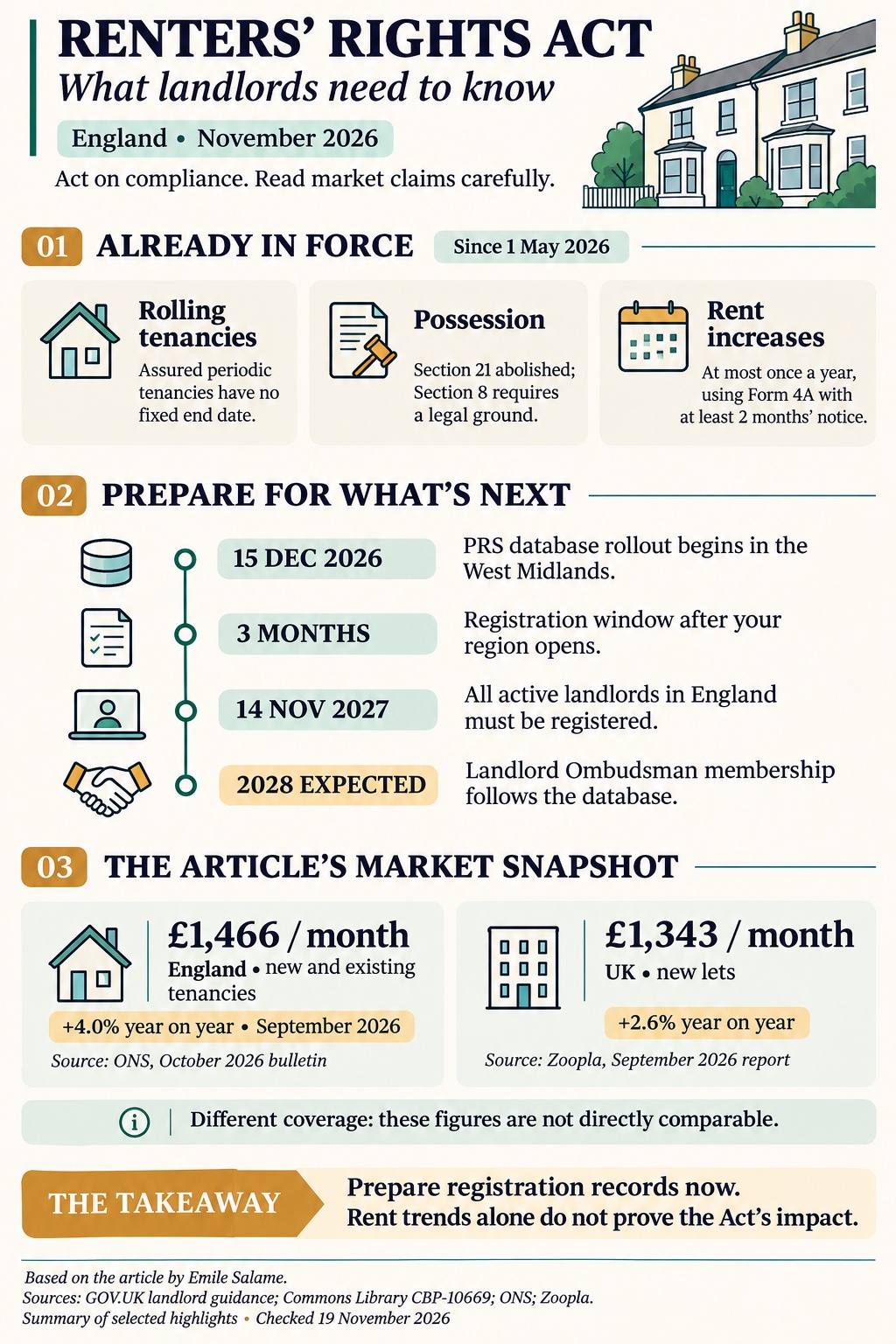
Rent can now rise only once a year, via Form 4A with two months’ notice, and tenants can challenge above-market increases. Landlords must publish an asking rent, cannot accept higher bids or take rent before signing, and cannot refuse tenants who receive benefits or have children. Maximum rent repayment orders have doubled to two years’ rent.
The next milestones
Next comes the Private Rented Sector Database, launching in the West Midlands on 15 December 2026 and rolling out region by region to the South West in August 2027. Landlords will have three months to register once their region opens, and all must be registered by 14 November 2027. Each property needs an entry with gas safety, electrical and EPC records, rent and licensing details, updated within 28 days of any change and renewed annually for a fee.
The Private Rented Sector Landlord Ombudsman follows, expected in 2028. Further out, landlords must meet EPC C (or hold a valid exemption) by 1 October 2030 and a decent homes standard by 2035, and a consultation on extending Awaab’s Law to private rentals closes on 18 December 2026.
Separating compliance from tax risk and commentary
Compliance obligations are settled law with fixed deadlines and penalties. Tax risk is speculative: Knight Frank has flagged a rumoured alignment of capital gains and income tax rates, which is not policy. Market commentary is interpretation, including claims about why rents are moving.
What the data shows
The Office for National Statistics reports that average private rent in England reached £1,466 in September 2026, up 4% year on year. Growth was strongest in the North West at 5.7% and weakest in London and the South East, both at 3.5%. These figures cover existing and new tenancies.
Zoopla’s new-let data tells a supply story: the average UK new-let rent was £1,343 in September, up 2.6%, with available stock down 3%, new listings down 6% and 5.3 enquiries per property, the highest in almost two years.
The causes are disputed. Knight Frank links higher prime London rents partly to landlords selling up because of the Act. Zoopla notes that Scotland shows the same pattern under similar long-standing rules and argues that market forces, including higher mortgage rates keeping would-be buyers renting, matter more. The data cannot yet isolate the Act’s effect.
Open the full-size infographic
What to monitor next
Database registration: Note your region’s start date, its three-month registration window and the fee.
Ombudsman designation: Watch for the operator, launch date and membership costs.
Possession timelines: Track how quickly courts process Section 8 claims.
Tax announcements: Separate confirmed Budget measures from rumour.
Market data: The next ONS release is due 18 November 2026; Zoopla’s stock figures will show whether supply keeps tightening.
The Act’s legal framework is now largely in place. The investors best positioned for the next phase will treat registration as a near-term compliance project and read market data without assuming the Act explains every move.
Sources
- GOV.UK — Renters’ Rights Act: An Overview for Landlords
- House of Commons Library — Renters’ reform in England: What’s happening and when? (Research Briefing CBP-10669)
- GOV.UK — The Renters’ Rights Act Information Sheet 2026
- GOV.UK — Implementing the Renters’ Rights Act 2025: Our Roadmap for Reforming the Private Rented Sector
- legislation.gov.uk — The Private Rented Sector Database Regulations 2026
- Knight Frank — Rental Market Adjusts to Reforms and Future Tax Risks
- ONS — Private Rent and House Prices, UK: October 2026
- Zoopla — Rental Market Report: September 2026
The presentation below summarises the Renters’ Rights Act changes and what landlords should monitor next.